

The Value Chain
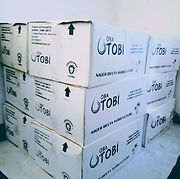
Our activities include input supply, production, processing, packaging, marketing, and distribution of various tropical flours under the Oba Tobi brand name in Nigeria. SME's in this part of the world are critical for food security and employment, linking smallholder farmers to local, regional, and export markets.

Grower
Our farming methods are anchored on ancient agricultural values such as the intercropping.

Processor
In Nigeria, rural women control majority of the activities involved in traditional flour processing.
Packager
Value addition at raw material source

Distributor
We sell wholesale product directly into various commodity markets, and we sell in branded packaging.
Our Flours
West African cuisine utilizes several distinct types of flour derived from dried yam, cassava, & plantain, often processed through fermentation, sun-drying, or milling to achieve specific textures for traditional "swallow" dishes like Amala or Fufu. At Abodunde Farms we process dried cassava, yam and plantain into 100% natural flour, with no additives.
African yams are the foundational starch for sub-Saharan civilizations. Today, West Africa remains the global heart of production, accounting for over 90% of the world’s harvest.


The importance of cassava to West Africans is epitomized in the Ewe (a language spoken in Ghana, Togo and Benin) name for the plant, Agbeli, meaning "There is Life”.
In the Yoruba language of West Africa, the saying, "Ogede n’ n’idi, o n’ n’ omo," likens the plantain’s ability to sprout new shoots from its base to a family’s continuity and prosperity.

Cassava flour, yam flour, and plantain flour are all popular, gluten-free staples in West African cuisine, used primarily to create "swallow" (or fufu), but they differ significantly in taste, texture, fermentation, and nutritional profile.
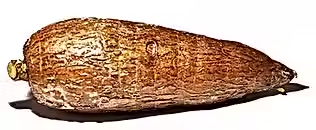
The Cassava plant root is known as "The Bread of the Tropics".
.avif)
Preparing Cassava flour in Central America, 1909.
Cassava was unknown to the Old World before the discovery of America. There is archaeological evidence of two major centers of origin for this crop, one in Mexico and Central America and the other in northeastern Brazil.
Portuguese settlers found the native Indians in Brazil growing the cassava plant and Pierre Martyr wrote in 1494 that the "poisonous roots" of a yucca were used in the preparation of bread.
It is believed that cassava was introduced to the western coast of Africa in about the sixteenth century by slave merchants where it quickly became an important crop.
Cassava is the third-largest source of food carbohydrates in the tropics, after rice and maize. Today, Nigeria accounts for 20% of total global output.